Solo Exhibition · National Gallery, 2021
Triptychos
The National Gallery
Solo exhibition at the Georgian National Museum and Window Project, National Gallery Tbilisi, 2021.
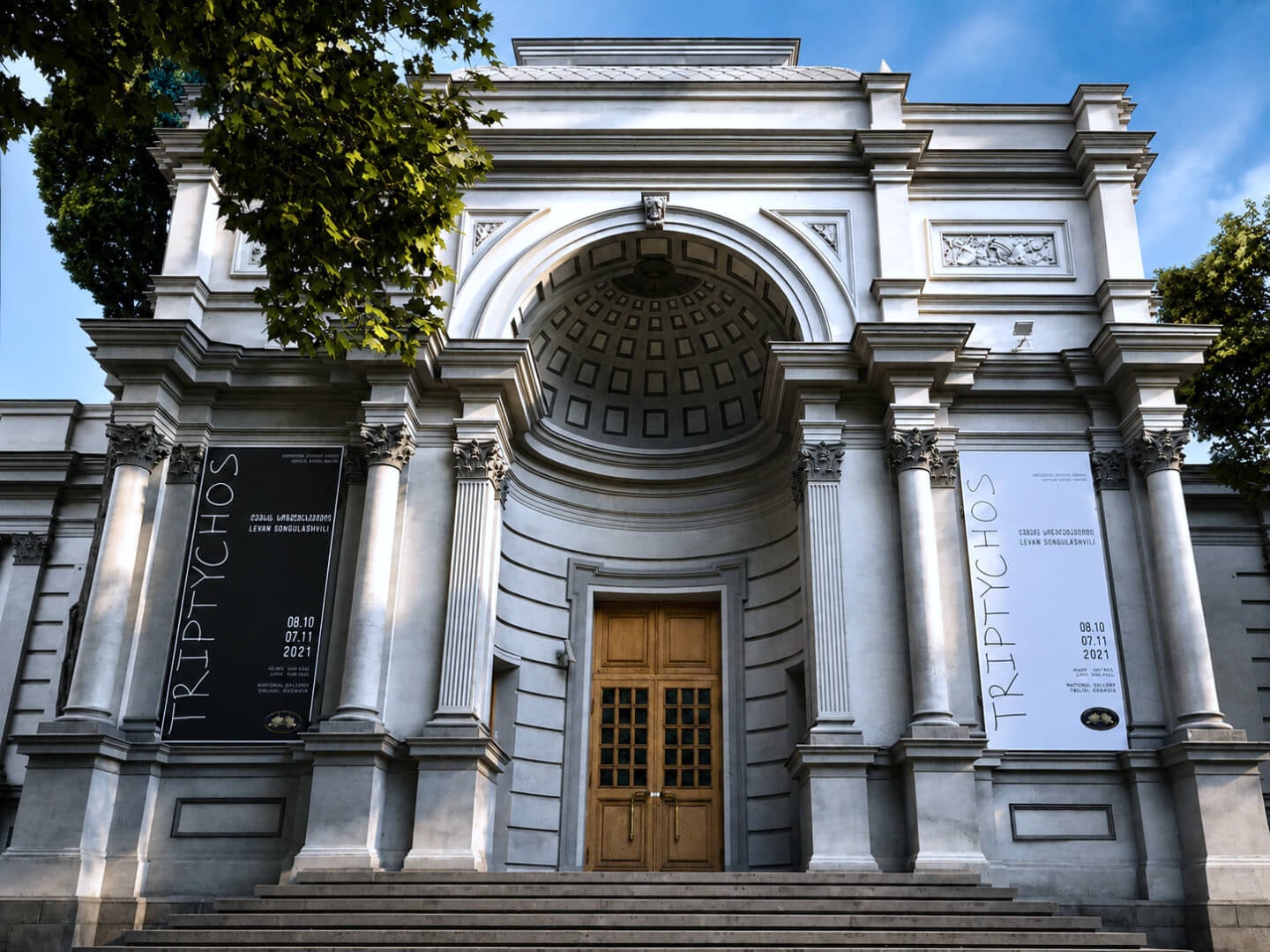
In 2021, The Georgian National Museum and Window Project presented Levan Songulashvili's solo exhibition, Triptychos, at the National Gallery. The exhibition spanned three rooms in the museum, consisting of drawings, murals, installation works, sound, sculpture and a painting.
Dealing and coping with watching a loved one die is a challenging process in which many contradictory stages and feelings — such as sadness, fear, regret, hope, love, anxiety, and anger — overlap and merge into each other in a restless movement. Without any defined borders, this process constantly evolves the witness mentally, emotionally, and even physically. The Georgian artist Levan Songulashvili channelises the upsetting experience of losing his beloved mother into a body of work which delicately conceals his personal narrative. The work takes the shape of an exhibition which spans three rooms in the National Gallery of Georgia.
Referring to the Greek word triptychos, which connotes "three folds or layers", a triptych often signifies a coherent artwork or piece — of visual arts, literature, or music — consisting of three complimenting or contrasting parts of a narrative, sequence, or pattern. With this exhibition, Songulashvili proposes a site-specific triptych. The entire exhibition transforms two-dimensional visualities into a three-dimensional multimodal sense by altering static spaces into dynamic and stimulating experiences.
The exhibition starts with a dreamlike — almost haunted — birch tree forest, "Milky Way" ("The Leap of the Deer"). The site-specific installation with soft light over murals and countless painted trees calls the viewer into another universe. The monochrome forest surrounds the viewer with a tidal sensation, while a fragile glass deer is delicately hidden among the trees, watching back.
The second room requires a step into darkness, accompanied by the sound of a breathing machine. A cube located at the centre of the gallery space conceals a deep pit with a staggering depth — a metaphor of Nietzsche's aphorism, "if you gaze for long into an abyss, the abyss also gazes into you".
The final room breaks the background sound with fragments of György Ligeti's Requiem (1961), filling the room which contains the large-scale painting Elysium. The painting functions as a closure for the entire journey — the exhibition Triptychos in the end opens a door to an afterlife lightened by fond memories as a controversial coverage of grief.
“In the middle of the journey of our life I found myself within a dark wood where the straight way was lost.”— Dante Alighieri